
Written in Urban Alchemist’s editorial voice. General education, not medical advice, a personal clinical account, or a product recommendation.
A label deserves more than a quick answer
When we write about an ingredient from behind the counter, our responsibility is to explain what the name does—and does not—tell you. Kratom deserves that care. A plant name on a package is not a guarantee of safety, and a confident testimonial is not a clinical trial.
This field note explains the research and the differences between preparations. It is not a stock announcement, a product recommendation, or a guide to using kratom.
Leaf, extract and 7-OH are not interchangeable
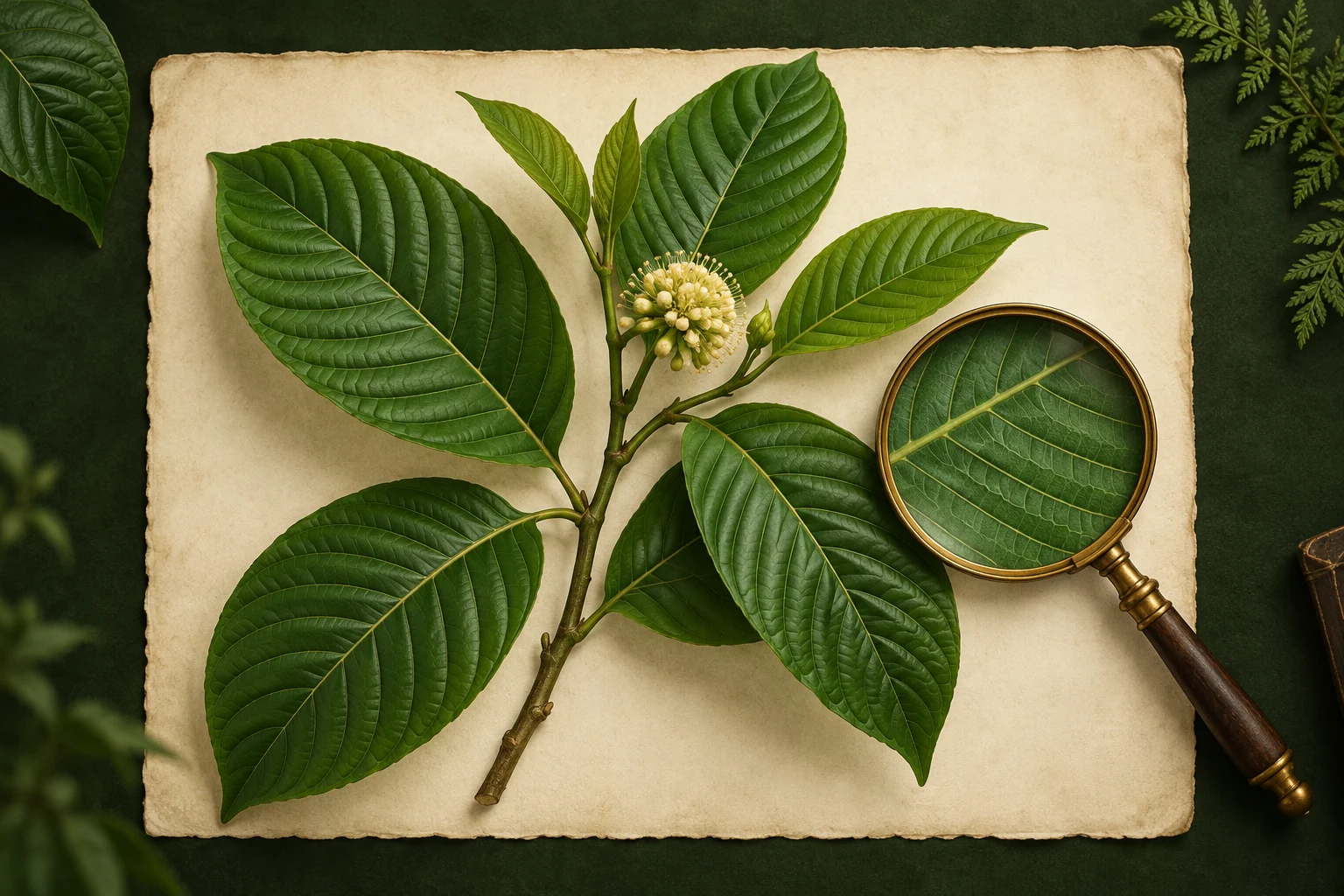
Kratom refers to Mitragyna speciosa, a Southeast Asian tree. Its leaves contain several alkaloids, including mitragynine and smaller amounts of 7-hydroxymitragynine, often abbreviated 7-OH. These compounds can act at opioid receptors. [1]
Leaf material and concentrated extracts are different preparations. A capsule or a shot describes a format, not a standardized chemical composition. The amount and proportion of alkaloids matter; the word “kratom” alone does not establish them.
Concentrated 7-OH products deserve particular attention. The FDA distinguishes these products from natural leaf and warns of serious harms, including addiction, seizures and potentially fatal breathing problems. A tablet, gummy or drink marketed with 7-OH should not be treated as equivalent to a traditional leaf preparation. That distinction also does not make leaf products risk-free. [1],[2]
Read past the benefit headline
Pain relief is a research question, but the evidence does not justify a shop treating kratom as a proven therapy. A 2020 randomized study examined 26 men who were already long-term daily users. Researchers measured tolerance of an ice-water pain task, not treatment of a chronic pain condition. [3]
The study reported an increase from baseline after kratom. However, its direct comparison of kratom versus placebo at one hour was not statistically significant for pain tolerance. That detail belongs beside the headline. A small experiment in experienced users cannot establish benefit or safety for someone new to kratom, a different preparation, or long-term use. [3]
Personal reports can explain why people are interested. They cannot establish cause and effect or replace a controlled treatment study. The FDA has not approved kratom for treating a medical condition. [1]
“Natural” does not settle the interaction question
In a 2023 clinical study involving 12 healthy adults, kratom increased exposure to midazolam, a medicine used to examine a drug-metabolism pathway. It did not have the same effect on the other probe medicine studied. This is human evidence that interactions deserve attention—not proof that every medicine behaves alike. [4]
That is a question for a pharmacist or clinician, with the actual ingredients and medication list in front of them. Combining substances based on a shop conversation or an online anecdote is not a safe substitute for that assessment.
Dependence and safety belong in the same conversation
The FDA warns about liver toxicity, seizures and substance use disorder associated with kratom. Reports of contamination are another reason a botanical label should not be mistaken for quality assurance. Evidence about one preparation does not automatically transfer to another. [1]
If someone is already using kratom regularly and is concerned about dependence or withdrawal, we would point them toward medical support rather than a self-directed substitution plan. For trouble breathing, unresponsiveness or a seizure, call 911. In the United States, Poison Control is available at 1-800-222-1222. [2]
What we want a responsible explanation to do
Separate the plant from the preparation. Separate a laboratory result from a health claim. Separate an early study from proof of treatment. These are not technicalities; they are the information a short sales pitch leaves out.
Our journal is a place to make those distinctions in plain language. If the evidence does not support a confident answer, saying so is part of doing the job properly.
Sources & further reading
- FDA: Kratom and its safety concerns
- FDA: Products containing 7-OH can cause serious harm
- Vicknasingam et al. (2020): Kratom and pain tolerance, randomized placebo-controlled study
- Tanna et al. (2023): Clinical assessment of kratom–drug interaction potential
Sources checked October 5, 2026. Research findings apply to the populations and preparations studied. This article is educational and does not establish a benefit for a product sold by Urban Alchemist.