
Written in Urban Alchemist’s editorial voice, informed by store materials and published research. General education, not a personal clinical account, medical advice or a claim that retail products cure disease.
Start with your day, then read the label
At Urban Alchemist, our idea of a useful shelf is one that invites curiosity. A warm mug, an unfamiliar flavor, a botanical ingredient with a story: those are good reasons to pause and look closer. They are not reasons to promise a cure.
Our store materials organize the collection around Clarity, Stamina, Calm, Seasonal, Ritual and Curious. Think of those as ways to browse, not clinical outcomes. This guide connects that approach with the questions behind functional mushroom coffee, drinks, gummies and botanicals.
Our September assortment records include Melting Forest mushroom coffee and drinks, plus Plant People WonderCalm and WonderFocus gummies. Those records establish examples we have carried, not today’s availability or the current formula. Check the actual package: a product name alone cannot verify its ingredients, effects or suitability.
Adaptogens, functional mushrooms and “tropical shrooms”
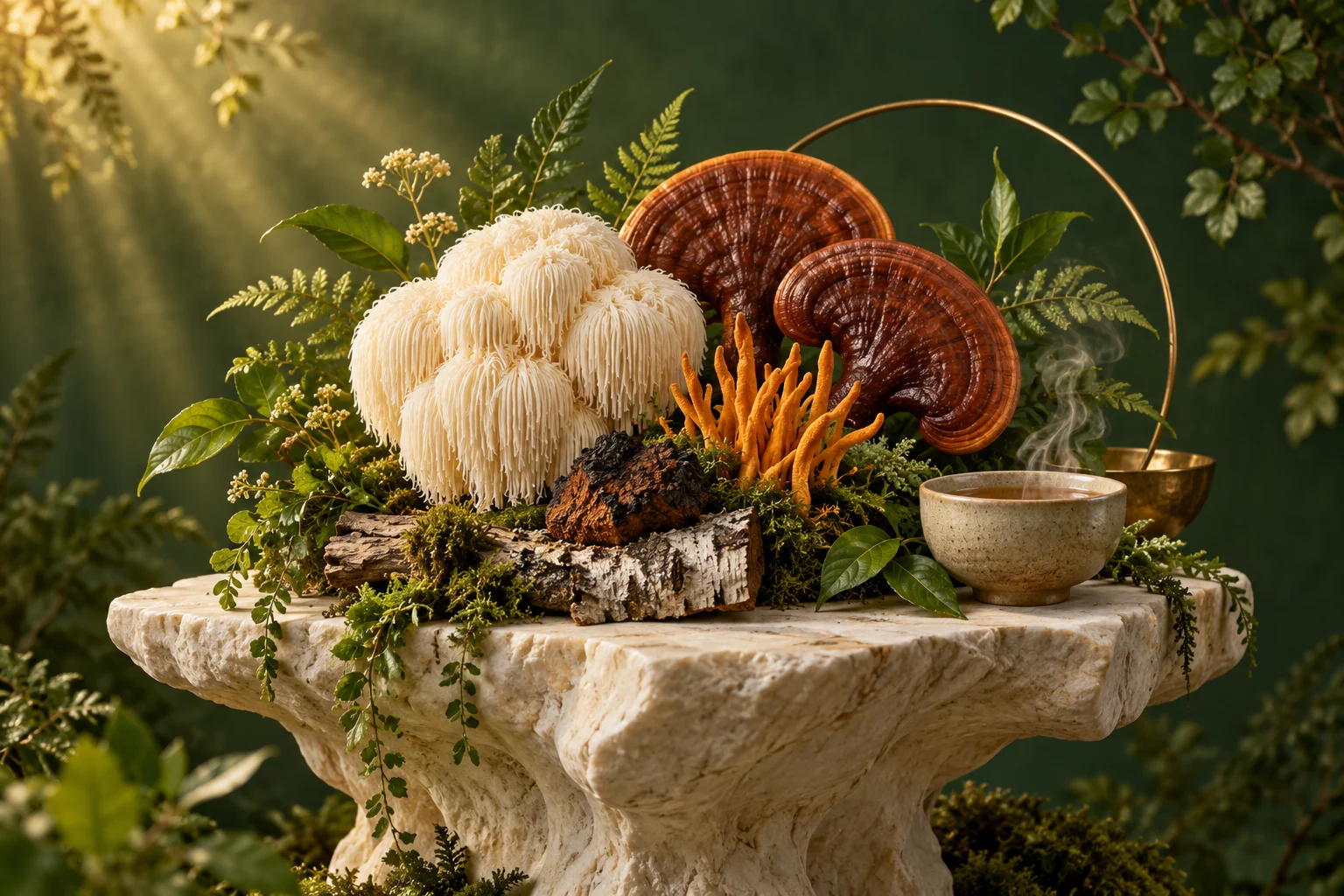
“Adaptogen” is a term used for ingredients promoted for helping the body respond to stress. It is not a single ingredient, and it does not mean a finished product has demonstrated a health benefit. Ashwagandha is a plant example; the functional mushroom category includes fungi such as lion’s mane, cordyceps, reishi and chaga. Each needs its own evidence.
“Tropical” on a drink or gummy can describe a flavor. It is not enough information to identify a mushroom species or predict an effect. Likewise, “shrooms” is too broad to tell us what is inside. Read the species, full ingredient list and testing information.
This article concerns non-psychedelic functional mushrooms and botanical products. They should not be confused with psilocybin or Amanita products. FDA says Amanita muscaria and certain constituents are not authorized ingredients in conventional food; a CDC investigation also found undisclosed substances in sampled mushroom gummies. That investigation was not a test of Urban Alchemist’s inventory. [7], [8]
Four mushrooms, four different evidence stories
Lion’s mane: a question about cognition
The white, shaggy mushroom is studied for cognitive effects. A 2009 trial randomized 30 adults with mild cognitive impairment and found better scores on one cognitive scale during supplementation; scores declined after stopping. It was small and involved a specific preparation and population, not a retail drink or healthy students preparing for exams. [1]
A 2023 pilot in healthy younger adults found faster performance on one task, but also null and some negative results. Its 28-day stress finding was a statistical trend, not a clear overall benefit. With 41 participants in the longer-term analysis, this is an interesting research lead, not proof of sharper everyday focus or a dementia treatment. [2]
Cordyceps: exercise research, not instant stamina
A randomized study of 28 people tested a mushroom blend containing cordyceps. After one week, the main treatment-by-time comparisons did not show significant effects. A three-week extension involved only 10 volunteers and suggested some improvements. Because it was a blend and a small study, the results cannot establish what cordyceps alone—or a particular canned drink—will do. [3]
Reishi: tradition deserves context
Reishi has a long history in traditional Asian medicine and appears in teas, powders and extracts. Human research is limited and does not justify turning an evening ritual into a promise to treat insomnia, anxiety or cancer. Memorial Sloan Kettering also flags bleeding risk with blood thinners and concerns for people taking immunosuppressants. [4]
Chaga: laboratory findings are not human outcomes
Chaga is associated with birch trees and often appears in tea or powder form. Antioxidant and immune-related laboratory findings do not show that drinking it prevents infections or treats cancer. Memorial Sloan Kettering notes the absence of clinical trials establishing these benefits and reports kidney injury associated with substantial, prolonged powder consumption. “Natural” does not make concentrated use harmless. [5]
How the formats on our shelves differ
| Format | Why someone might consider it | What to check |
|---|---|---|
| Mushroom coffee | A familiar morning preparation and a different flavor experience. | Coffee content, caffeine, named species and amount per serving. Mushroom branding does not establish reduced caffeine. |
| Functional drinks | A portable beverage with a flavor you enjoy. | All active ingredients, caffeine, sugar and serving size. “Energy” or “calm” is a claim to examine. |
| Supplement gummies | A convenient format for people who dislike powders. | Amount per piece versus per serving, sweeteners and every ingredient in the blend. Keep away from children. |
| Teas & botanicals | Taste, aroma and the act of making a cup. | Plant identity, caffeine, allergies and medication interactions. |
| Honey, snacks & ritual goods | Flavor, a small gift or a pleasant setting for a break. | Food ingredients and allergens; candle safety. Enjoyment does not require a medical claim. |
Capsules, tinctures and concentrated extracts are other formats you may encounter. A tea, a powder and an extract are not automatically equivalent just because the same mushroom name appears on all three. Verify the current assortment rather than assuming this guide is a stock list.
What about botanical adaptogens?
If a blend lists ashwagandha, assess that ingredient separately. NCCIH reports that some preparations may help stress or insomnia, while evidence for anxiety remains unclear. Trials are often small and use different preparations. That does not validate every “calm” gummy, and we are not assuming any named store product contains it.
Ashwagandha can cause digestive upset or drowsiness, has been linked to rare liver injury, and should be avoided during pregnancy and breastfeeding. Thyroid or autoimmune conditions and medication use warrant particular care; long-term safety remains uncertain. A clinician or pharmacist can review the exact label. [6]
What makes something worth choosing?
Our answer begins with something concrete: you like the flavor, the preparation suits your routine, the ingredients are clearly identified, and the cost makes sense to you. A cup of tea can be worthwhile because you enjoy it. It does not need to be marketed as a treatment.
For a supplement, ask a harder question: was this ingredient, in this preparation, studied in people like me for the outcome I care about? A long ingredient list, a dramatic extract ratio or an attractive label cannot answer that. A matching batch report can help establish composition and screened contaminants; it cannot prove a health benefit.
No one needs to buy the whole shelf. Persistent fatigue, memory changes, anxiety or sleep difficulties deserve assessment rather than a growing collection of supplements. Tell your healthcare professional what you take, especially with medications, pregnancy, planned surgery or kidney or liver problems.
For a closer look at formats and label questions, read our gummy field note. For the non-supplement side of the store, explore teas and botanicals and imported snacks. The value we aim to offer is a clearer conversation, without turning curiosity into a promise.
Sources & further reading
- Mori et al. (2009): Lion’s mane and mild cognitive impairment — randomized trial
- Docherty et al. (2023): Lion’s mane, cognition and mood — full-text pilot trial
- Hirsch et al. (2017): Cordyceps-containing mushroom blend and exercise — randomized trial
- Memorial Sloan Kettering: Reishi — clinical evidence and interactions
- Memorial Sloan Kettering: Chaga — evidence gaps and safety
- NCCIH: Ashwagandha — usefulness and safety
- FDA: Amanita muscaria and its constituents in food
- CDC (2024): Undisclosed substances identified in mushroom gummies
Sources checked October 7, 2026. Primary studies describe their own populations and preparations; they do not establish benefits for our retail inventory. Assortment examples come from September 2026 store records and may change.