
Written in Urban Alchemist’s editorial voice. General education, not medical advice, a personal clinical account, or a product recommendation.
The question behind “Which gummy?”
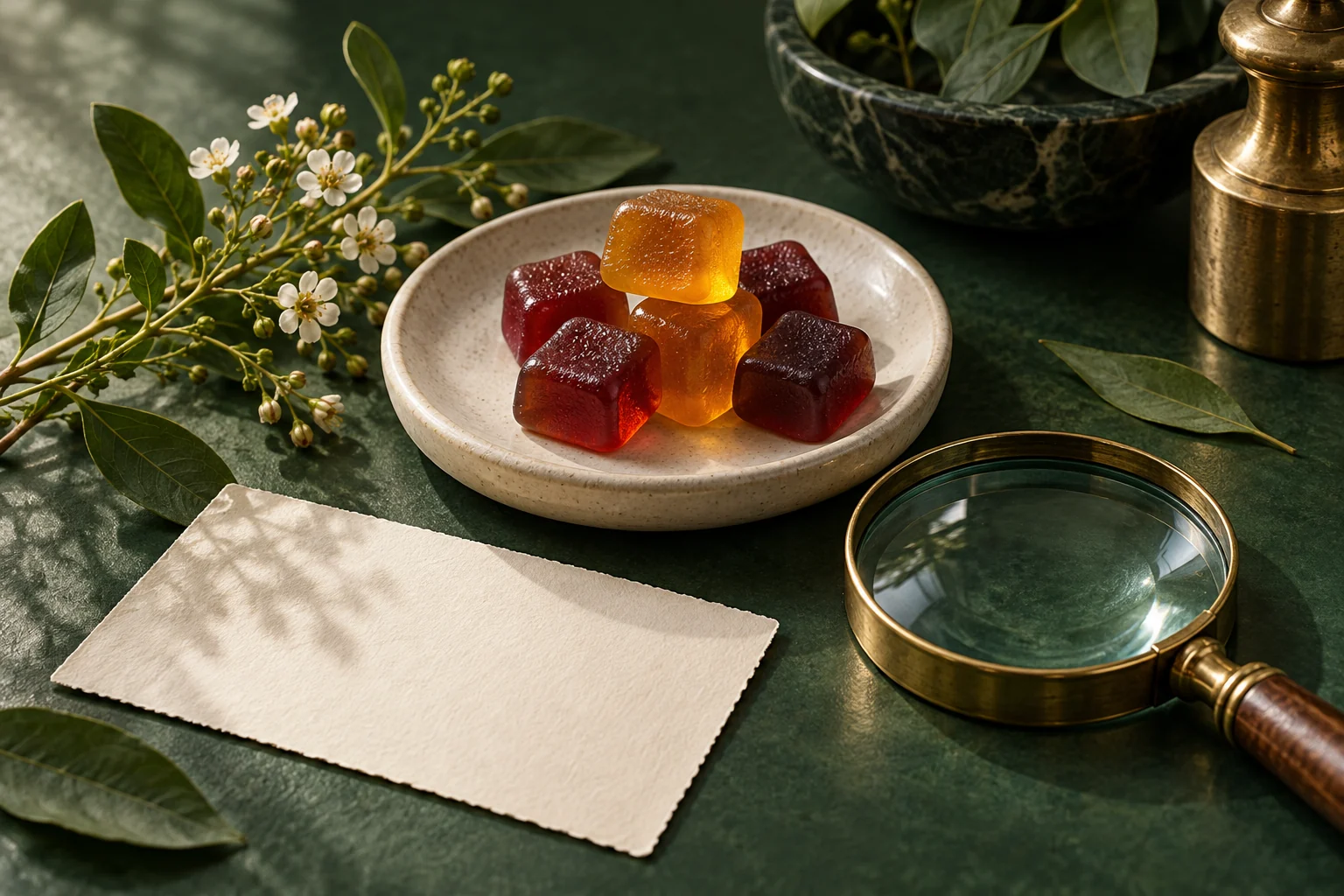
Our approach at the counter starts with a question: what is in it? A gummy tells you how something is packaged. It does not tell you whether it contains THC, CBD, another cannabinoid, melatonin, or simply candy ingredients. Two similar-looking pieces can mean very different things.
That distinction matters more to us than a flavor name or a large number on the front. This is a guide to reading the category, not a current stock list or a claim that every type below is available at Urban Alchemist.
Different types, different questions
| Label category | What to understand |
|---|---|
| THC-containing | Can intoxicate and impair. A familiar candy shape does not make the contents mild or predictable. |
| CBD | CBD differs from intoxicating THC, but is not risk-free. Interactions and liver injury are among FDA concerns. |
| CBN or cannabinoid blends | Read every active ingredient. An ingredient associated with sleep in marketing does not establish an effective treatment. |
| Melatonin or other supplements | A separate ingredient category. Do not infer a cannabinoid content, or a proven outcome, from the word “gummy.” |
| Ordinary confectionery | Check ingredients and allergens. Appearance alone cannot distinguish candy from an infused product. |
These distinctions are why we would rather slow down over a label than treat all gummies as one product. [1],[2],[3],[5]
What can we honestly say about benefits?
Convenient packaging is not the same as a demonstrated health benefit. Claims about better sleep, less stress or pain relief need evidence for the particular ingredient, formulation and outcome—not just a story about how someone felt.
The FDA-approved prescription CBD medicine used for specific seizure disorders is not evidence that a retail CBD gummy treats anxiety, pain or insomnia. Unapproved retail formulations have not gone through the same evaluation. [2]
CBN illustrates the gap between a promising question and a settled answer. A seven-night 2024 randomized trial, whose authors reported affiliations with Canopy Growth and Wana Brands, analyzed 293 participants and found improvements in some self-reported sleep measures, but the overall sleep-quality difference was not statistically significant. Adding CBD did not establish an extra benefit. [3]
A 2026 single-night crossover trial in 20 adults with insomnia found no significant improvement in its primary measure, time awake after initially falling asleep. Some secondary outcomes improved in one study condition. Small, short studies of specific preparations cannot verify a retail gummy’s benefits or long-term safety. These study conditions are not dosing advice. [4]
Turn the package over
First, separate the amount per piece, the serving size and the total in the package. Then read the full ingredient list rather than relying on the largest front-label number. If a laboratory report is supplied, check that its batch matches the package and notice which substances it actually measures.
Testing can help answer a composition question; it does not prove that a product treats a condition. Nor should a familiar format substitute for verification: a 2023 JAMA analysis found substantial differences between labeled and measured melatonin in sampled gummies. That study is a reason to scrutinize labels, not a finding about our own inventory. [5]
The part of the conversation we do not skip
Edible cannabis can have delayed and unpredictable effects. The CDC notes that effects can take 30 minutes to two hours to appear and can last longer than expected; consuming more before effects appear increases the risk of poisoning. Keep infused products secured away from children and pets, and do not drive while impaired. [1]
A clinician or pharmacist is the right person for questions involving medications, a health condition, pregnancy, or persistent sleep problems. We can explain what a label says; we cannot turn a retail conversation into a diagnosis or treatment plan.
For the chemistry behind cannabinoid names, continue with our THCA vs. THC field note. Our standard for a useful conversation is simple: leave with clearer questions, even if that means leaving without a product.
Sources & further reading
- CDC: Cannabis and Poisoning
- FDA: What to know about cannabis-derived products, including CBD
- Bonn-Miller et al. (2024): CBN with and without CBD on sleep quality
- Lavender et al. (2026): Cannabinol for acute treatment of insomnia disorder
- Cohen et al. (2023), JAMA: Quantity of melatonin and CBD in melatonin gummies
Sources checked October 5, 2026. Research findings apply to the populations and preparations studied. This article is educational and does not establish a benefit for a product sold by Urban Alchemist.