
An evidence-led field note · No. 01
THCA vs. THC:
one letter.
A real difference.
From flower labels to gummies and drinks: answers to the questions that come up in store, with a closer look at benefit claims and the evidence behind them.
releases CO₂
Closely related molecules.
Different pharmacology.
THCA is the acidic precursor of delta-9 THC. It is generally described as non-intoxicating in its unheated form; THC produces the characteristic cannabis high. Heat can convert THCA into THC, so a THCA label does not guarantee a non-intoxicating experience. [1] [2]
From the conversations at Urban Alchemist
“Is this THCA or THC?” is a real question.
That question comes up in our store conversations, alongside another: what is actually in the product? The discussions behind this guide cover flower, gummies, drinks, CBD and functional mushroom products. Similar-looking packages can contain very different ingredients.
Those conversations also start with everyday concerns: winding down, sleep, anxiety, discomfort, or simply understanding an unfamiliar label. Here, we separate the question someone is asking from what research can substantiate. A personal experience or a shelf name cannot establish a medical benefit.
Editorial context comes from Urban Alchemist’s store and staff conversations. Categories are discussed for education, not as a live inventory list. Scientific statements are sourced below.
Different formats. Different label questions.
The form of a product does not identify its active ingredients. Read the ingredient names and the accompanying test information before drawing a conclusion from the package.
Separate THCA from THC.
A THCA result describes the acidic form measured before heating. It does not mean the material stays non-intoxicating after heating. Compare the THCA, delta-9 THC and total-THC fields rather than looking at just one number. [1]
Read the whole package.
Check which cannabinoids are listed, whether amounts refer to one serving or the entire container, and the number of servings. A gummy and a beverage are both ingested formats; appearance and flavor do not establish strength. Effects may be delayed and unpredictable. [8]
CBD is a different compound.
CBD is not another spelling of THCA. A CBD label also does not establish that a product treats anxiety or sleep problems. FDA notes that unapproved CBD products have not been evaluated for claimed effectiveness and can present risks, including drug interactions. [10]
Keep ingredient categories separate.
Store conversations also mention tea and functional mushrooms. These are separate ingredient categories, not synonyms for THC or THCA. Check a blend’s full ingredient list; a cannabinoid study is not evidence for a mushroom blend, or vice versa.
For all of these formats, the useful question is specific: what ingredient, in what formulation, was actually studied? This guide does not rank products, suggest a dose, or verify a particular batch.
What about benefits for sleep, anxiety or pain?
These concerns recur in the store discussions. The evidence needs to be matched to the exact compound, preparation and condition—not transferred from a research paper to everything on a shelf.
Where clinical benefits have been established
Some prescription cannabinoid medicines have specific approved uses. For example, dronabinol (synthetic THC) and nabilone are used for chemotherapy-related nausea and vomiting. Approval of a prescribed medicine does not establish the same benefit for retail flower, gummies, drinks or THCA. [11]
Where the answer is more limited
- Pain: reviews of cannabis and cannabinoids have found small benefits in some chronic-pain settings, alongside more adverse effects. That is not evidence that a particular store product will relieve pain.
- Sleep: some improvements come from studies in people with other health conditions; it is unclear whether sleep improved directly or because other symptoms improved.
- Anxiety: human evidence is limited. It does not justify a blanket anxiety-relief promise.
These distinctions follow NIH’s evidence summary. [11]
For THCA specifically, the papers discussed later are laboratory and animal studies. They do not establish those everyday clinical benefits. And feeling sleepy, intoxicated or temporarily different is not, by itself, evidence that an underlying condition has been treated.
If sleep, anxiety or persistent pain is affecting your life, a qualified clinician can help assess the cause and treatment options. Store conversations and product labels cannot provide that assessment.
What is the difference between THCA and THC?
“THC A,” “THCa” and “THCA” usually refer to tetrahydrocannabinolic acid. This article uses THCA for the naturally predominant THCA-A form, and THC for delta-9-tetrahydrocannabinol. The extra acid group changes the molecule’s properties; these names are not interchangeable. [2]
| Question | THCA | THC |
|---|---|---|
| Chemical form | Acidic precursor | Neutral cannabinoid |
| Typical intoxication | Not expected from pure, unheated THCA | Can produce a high and impairment |
| Effect of heating | Can convert to THC | Already in the neutral form |
| Evidence discussed here | Laboratory and animal studies | Receptor studies and public-health evidence |
Comparison based on sources 1, 2 and 7. A chemical distinction is not a safety guarantee.
What changes when THCA is heated?
The process is called decarboxylation: THCA loses carbon dioxide and becomes THC. Wang and colleagues directly measured acidic and neutral cannabinoids in heated cannabis extracts. The rate changed with time and temperature under their controlled laboratory conditions. [1]
This explains why a material can test high in THCA before heating yet expose someone to THC afterward. It does not mean every real-world process converts everything perfectly. The study used a vacuum oven and analytical instruments; it was not a test of consumer devices or a measurement of the amount reaching a person’s bloodstream. [1]
What do the research papers actually show?
A result in a receptor assay or a mouse is a reason to investigate a compound further. It does not establish a treatment, an effective human dose, or long-term safety. Reading the methods matters as much as reading the headline.
THCA does not behave like THC at CB1
McPartland and colleagues found little affinity or activity for THCA-A at human CB1 and CB2 receptors in their assays. Their THCA reference material contained 2% THC, which could explain some apparent activity. That contamination problem helps explain why different experiments can disagree. These were laboratory assays, not a clinical trial. [2]
Promising mechanisms are still early evidence
Nadal and colleagues studied THCA’s activity at PPARγ, a receptor involved in gene regulation. They reported protective effects in cell experiments and a toxin-induced mouse model relevant to Huntington’s disease. The findings identify a possible biological mechanism. They do not show that THCA prevents or treats Huntington’s disease in people; a chemically induced mouse model cannot reproduce the full human condition. [3]
The findings are not uniformly positive
Benson and colleagues found that THCA’s effects differed across seizure models and depended on whether THC was present. Purified THCA did not help in one model; some conditions produced proconvulsant effects, and a THCA/THC mixture worsened outcomes in a Dravet-syndrome mouse model. These results neither predict a particular person’s response nor support presenting THCA as an established epilepsy treatment. [4]
Our reading of this evidence: the chemistry is much better established than THCA’s clinical benefits. The cited preclinical studies do not demonstrate that retail THCA products treat pain, inflammation, anxiety, seizures or neurodegenerative disease. A claim about a biological pathway should not be rewritten as a promise to a patient.
Why “total THC” matters on a lab report
THCA and delta-9 THC can appear as separate measurements. A commonly used calculation estimates the THC potentially available after conversion:
The 0.877 factor accounts for the molecular mass lost as carbon dioxide. It is not an absorption rate or a prediction of impairment. [5]
For a purely hypothetical sample containing 10% THCA and 0.20% delta-9 THC, the calculation gives 8.97% potential total THC. That is a chemistry example, not a dose recommendation. The actual amount delivered to the body depends on more than this calculation. [5]
USDA’s hemp-production testing guidance explicitly accounts for THCA’s potential conversion to THC and requires results on a dry-weight basis. That crop-testing framework should not be mistaken for a blanket determination that a finished retail product is lawful. [6]
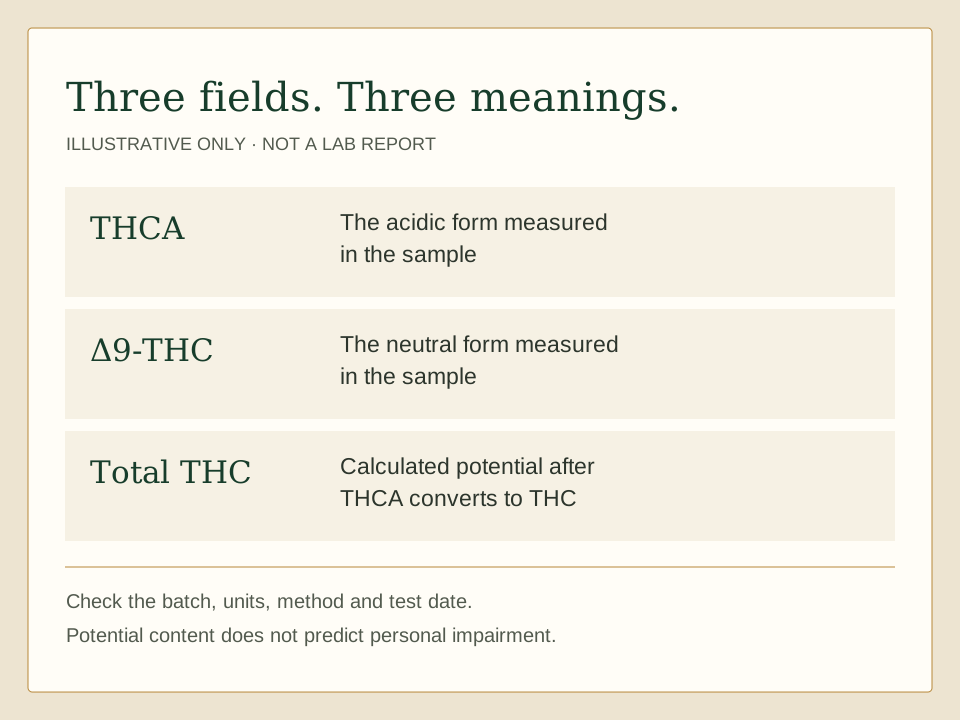
Questions to ask of a certificate of analysis
- Does the sample or batch identifier match the material being described?
- Are THCA, delta-9 THC and calculated total THC distinguished?
- Are the units clear: percent by mass, mg/g or something else?
- Does the report identify its date, test method and measurement uncertainty?
- Which contaminants were actually tested? A potency result alone does not answer that question.
These are practical report-reading questions, not a certification of a product’s safety or legal status. USDA’s guidance explains why methods and uncertainty matter. [6]
Different molecules do not mean risk-free products
THC can impair attention, judgment, coordination and reaction time. A product described as THCA may expose someone to THC after heating. Do not drive or operate machinery while impaired; combining cannabis with alcohol can increase impairment. [7]
Edible cannabis presents a different timing problem: effects may take 30 minutes to two hours to appear and can last longer than expected. Delayed effects can contribute to accidental overconsumption. Keep cannabis products away from children and pets. For suspected poisoning in the U.S., call Poison Control at 1-800-222-1222; call 911 for an emergency. [8]
Cannabis also carries risks involving memory, mental health and dependence; smoke can damage lung tissue. The degree of risk depends on the person and the pattern of exposure. A “natural” label or a high purity percentage does not remove these concerns. [9]
THCA and THC are chemically related, but they are not pharmacologically identical. Heating connects the two. Lab reports describe a tested sample. Clinical benefits require clinical evidence. Those distinctions are more useful than treating either molecule as automatically safe or universally beneficial.
THCA labels and Illinois rules: separate chemistry from legality
A low delta-9 THC number or the word “hemp” does not settle a product’s legal status. Illinois’ June 2026 bulletin describes immediate age-verification and labeling requirements, and a new framework taking effect November 12, 2026. The forthcoming definition includes THCA in total THC and excludes final cannabinoid products exceeding 0.4 mg combined total per container of the specified cannabinoids. Read the Illinois Department of Agriculture bulletin for the definitions and effective dates.
A retail description such as “wellness boutique” does not create an exemption. This article does not determine whether a particular product may be sold.
Federal food and drug requirements are a separate question. FDA explains that hemp status does not remove applicable food and drug obligations, and that THC and CBD products are excluded from its dietary-supplement definition. Its cannabis regulation questions and answers distinguish product use, labeling and marketing. A lab report is not FDA approval.
Keep the next question specific
If your question is about a gummy’s serving size or ingredients, continue with our gummy format and evidence guide. For tea and mushroom ingredients, use the tea and botanical collection guide and functional mushroom research notes. Those categories should not inherit cannabinoid claims.
For local contact information rather than a product recommendation, see visiting Urban Alchemist on Clybourn Avenue.
Sources & reading notes
Prepared from the primary research papers and official sources linked below, with questions informed by store conversations. Transcript anecdotes are not used as scientific evidence. Illinois and FDA regulatory sources checked October 9, 2026; the scientific review was prepared October 5, 2026. This is a focused educational review, not a systematic review or medical guidance. Publication years refer to journal issues where an earlier online publication exists.
- Wang M et al. (2016). Decarboxylation Study of Acidic Cannabinoids. Cannabis and Cannabinoid Research, 1:262–271.Laboratory chemistry • DOI: 10.1089/can.2016.0020
- McPartland JM et al. (2017). Affinity and Efficacy Studies of Tetrahydrocannabinolic Acid A at Cannabinoid Receptor Types One and Two.Receptor experiments • DOI: 10.1089/can.2016.0032
- Nadal X et al. (2017). Tetrahydrocannabinolic acid is a potent PPARγ agonist with neuroprotective activity. British Journal of Pharmacology, 174:4263–4276.Cells and mice • DOI: 10.1111/bph.14019
- Benson MJ et al. (2022; first published online 2020). Evaluation of the Possible Anticonvulsant Effect of Δ9-Tetrahydrocannabinolic Acid in Murine Seizure Models.Mouse experiments • DOI: 10.1089/can.2020.0073
- USDA (2021). Establishment of a Domestic Hemp Production Program. Federal Register, 86 FR 5596.Primary regulatory source • Molecular-mass conversion and total THC
- USDA. Laboratory Testing Guidelines, U.S. Domestic Hemp Production Program.Official guidance • Crop testing, methods and measurement uncertainty
- CDC. Cannabis and Driving.Public-health guidance • Impairment and driving
- CDC. Cannabis and Poisoning.Public-health guidance • Delayed effects and accidental exposure
- CDC. Cannabis Health Effects.Public-health guidance • Brain, lung and mental-health risks
- FDA. What You Need to Know About Products Containing Cannabis or Cannabis-derived Compounds, Including CBD.Official consumer guidance • Unapproved CBD claims, safety and interactions
- NIH / NCCIH. Cannabis (Marijuana) and Cannabinoids: What You Need To Know.Evidence summary • Prescription medicines, pain, sleep and anxiety